Evolution Toward Intelligent Compensation
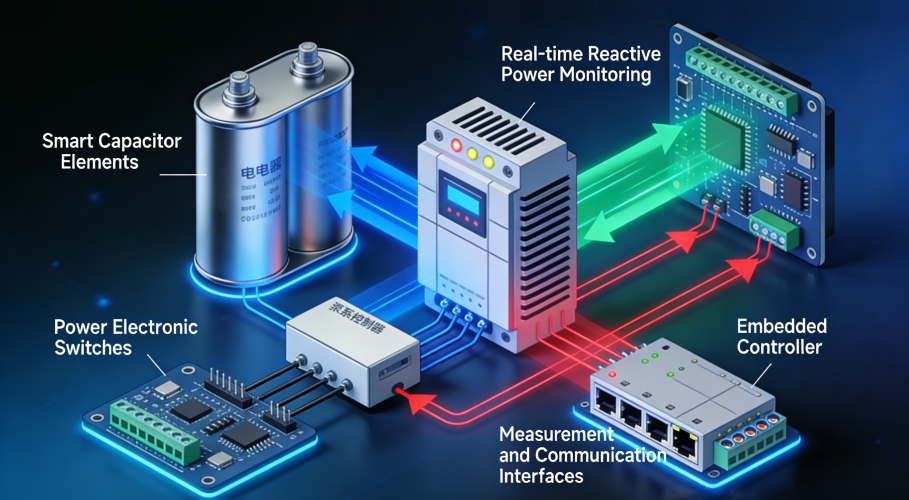
Smart Capacitors represent an evolution from passive compensation devices to integrated reactive power management units. By combining sensing, switching, and communication functions, smart capacitors address limitations inherent in conventional capacitor banks.
Functional Architecture
A smart capacitor typically integrates: - Capacitor elements - Power electronic switching devices - Embedded Controllers - Measurement and communication interfaces
This integration enables localized decision-making based on real-time electrical conditions.
Performance Advantages
Smart capacitors improve compensation efficiency by responding rapidly to load changes. Zero-crossing switching minimizes transient disturbances, while embedded logic prevents overcompensation and resonance conditions.
In IEC-oriented systems with fluctuating loads, this adaptability enhances both power factor stability and equipment lifespan.
Application Contexts
Smart capacitors are particularly valuable in: - Manufacturing lines with cyclic loads - Commercial buildings with variable occupancy - Distribution networks with renewable energy sources
Their decentralized control philosophy aligns with modern power quality management strategies.
Implementation Considerations
Despite their advantages, smart capacitors require careful system integration. Communication protocols, coordination with central controllers, and lifecycle cost analysis must be addressed during design.
FAQ
Do smart capacitors eliminate the need for central controllers?
They reduce dependence but do not always fully replace centralized coordination.
Are smart capacitors compatible with harmonic mitigation?
Yes, when combined with appropriate filtering or detuning solutions.

 English
 Español
 Portugues
 Pусский
 Français
 Deutsch
 日本語
日本語
 한국어
한국어
 العربية
 Italiano
 Nederlands
 Svenska
 Polski
 Türk dili
 हिन्दी
 Indonesia
 Melayu
 dansk
dansk
 Magyar
 қазақ
қазақ
 বাংলা
বাংলা
 עִברִית
 čeština
 українська
 беларускі
 Filipino
 Suomalainen
 اردو
اردو
 հայերեն
 български
 Hrvatski
 नेपाल
नेपाल
 euskara
 Shqipëria
 Malagasy
 Башҡорт
 Türkmenler
 Ilocano
 Нохчийн



 Whatsapp
 Teléfono
Comenta
(0)